
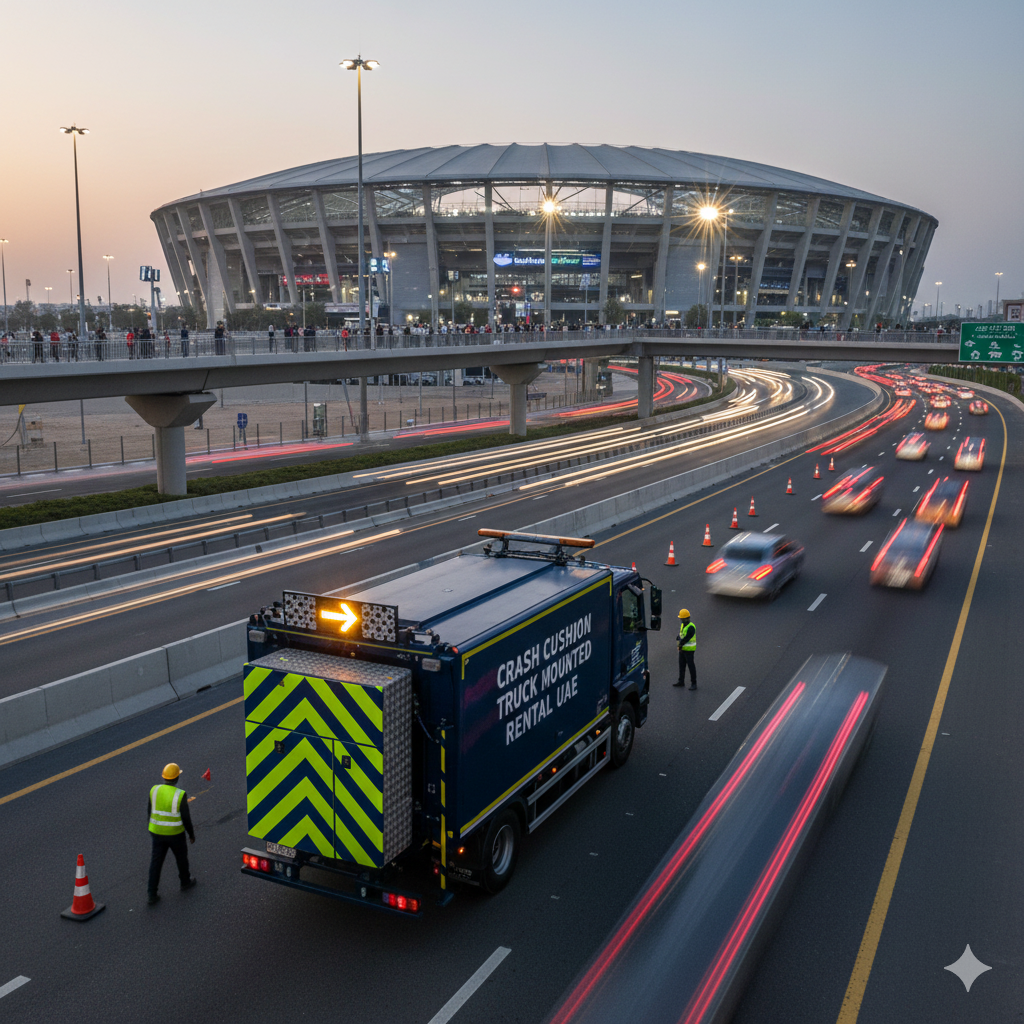
The Science of Safety: How a Crash Cushion Truck Mounted Unit Saves Lives
In the landscape of Dubai’s road safety, the crash cushion truck mounted unit is often seen but rarely understood. To the average motorist, it’s a yellow box on the back of a truck. To a safety engineer, it is a sophisticated piece of life-saving technology governed by the laws of thermodynamics and structural mechanics.
As we look at the safety requirements for 2026, understanding the why behind the equipment is as important as the how.
1. Kinetic Energy: The Invisible Enemy
When a vehicle travels at high speeds on the Emirates Road, it carries a massive amount of kinetic energy ($E_k$). The formula is simple but deadly:
Because velocity ($v$) is squared, even a small increase in speed leads to a massive jump in impact energy. A car hitting a stationary object at 100 km/h has four times the destructive energy of a car at 50 km/h.
A crash cushion truck mounted unit is designed to act as a giant “crumple zone.” Instead of that energy being transferred into the driver’s body or the work crew, the attenuator absorbs it by deforming its internal structure—typically made of specialized aluminum honeycomb or high-density composite cartridges.
2. Managing the “Ride-Down” Time
Survival in a crash isn’t just about stopping; it’s about how fast you stop. If a car hits a concrete barrier, the stop is near-instantaneous, leading to extreme G-forces that cause internal injuries.
The engineering of a tma rental dubai vehicle focuses on “Ride-Down Time.” By collapsing predictably over several feet, the attenuator extends the duration of the crash. This reduces the Acceleration Severity Index (ASI), keeping G-forces within a range that the human body can survive.
3. MASH TL-3: The 2026 Engineering Gold Standard
In 2026, the RTA mandates MASH TL-3 (Test Level 3) for high-speed roads. But what does that actually mean for the hardware?
Heavy Vehicle Testing: Unlike older standards, MASH TL-3 requires the unit to successfully stop a 2,270 kg (5,000 lb) pickup truck.
Structural Integrity: The truck mounted attenuator manufacturers must prove the unit won’t “pocket” or “vault” the striking vehicle. It must capture the car and bring it to a linear stop.
Anti-Underride: The host truck must have a minimum mass (often over 10,000 kg) to ensure that the impact doesn’t push the safety vehicle into the workers—a phenomenon known as “roll-ahead.”
4. The Sacrificial Design: One and Done
A critical point for contractors to understand is that these units are sacrificial. Once a crash cushion truck mounted unit has been impacted, its internal structure is compromised. It has done its job by “dying” to save a life.
Under dubai road safety regulations, an impacted TMA must be replaced immediately. This is why our tma vehicle rental service includes a 24-hour rapid-swap protocol. Using a “repaired” or partially crushed unit is not only illegal in 2026 but engineering-wise, it offers zero protection for the next impact.
5. Conspicuity: Prevention Through Visibility
The best crash is the one that never happens. This is why 2026 units are equipped with:
Active LED Arrow Boards: Guiding motorists into safe lanes far in advance.
Reflective Chevrons: Meeting the latest RTA 500-meter visibility standards.
Intelligent Warning Systems: Some shadow vehicle with tma units now feature AI sensors that trigger sirens if a vehicle is approaching at a dangerous speed or angle.
Conclusion: Physics in the Service of People
The science behind the crash cushion truck mounted unit is a testament to modern engineering. By respecting the physics of the road and the vulnerability of the human body, these devices ensure that Dubai’s progress never comes at the cost of safety.
Information
Services
Contact Us
- +971 55 172 7024
- Earthmoversinfo@gmail.com
- Capital Golden Tower Office 706 – 7 floor – Dubai